A brief history of the Abbey Fields Lake
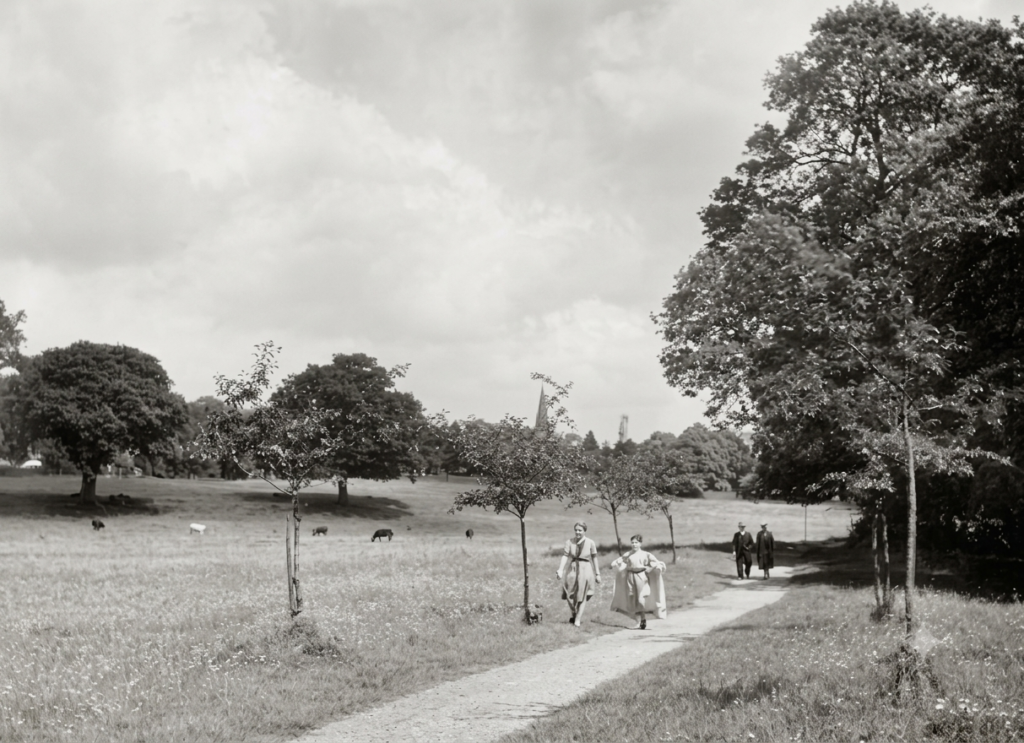
The Oxpen Meadow, taken from a c1957 town guide
The probable history of the lake in the time of the Priory and Abbey, is best explained by David Brock, in Kenilworth History 2004-5. It began as one pool stretching far down the Luzley Brook and into today’s Castle Farm, covering nearly all the low-lying western half of the park; it was reduced to the area north of Finham Brook during the time of the Abbey. This may have also have been the time that the current course of the brook through the park was excavated, and a raised area constructed to separate it from the lake.
The precise level of the lake was altered at different times throughout its existence; one former bank with a row of trees is easily picked out at the lower end of the slope down from High Street. The pool’s exact depth has never been established. There was thought to be a boathouse at the northeastern corner.
Best educated guesses say the lake was drained sometime soon after the dissolution of the Abbey in 1538; this may be the other possible time that today’s course of the brook was dug, and an embankment built to stop the former lake from flooding again.
It is marked as The Abbey Meadow on a 1695 map, and by the late 1870s, when it was being rented out as pasture used for grazing livestock, it was flooded in the winter to provide skating for 3d a time. There was presumably a control method for the water at each end, in and out. It was now known as the Oxpen Meadow.
Prior to, but particularly just after, the purchase of the fields to become a park in 1884, there were calls for the lake to be re-introduced for boating and fishing to provide an income from the park, and a plan showing a lake was drawn up in 1885; ‘The pond exists, we just need the water’. It was still dry enough to be rented out for gazing livestock annually.
One argument against making a lake was that it ‘would give further facilities for drowning accidents’. Another was that there was a great difference between flooding to a depth of a few inches for skating than creating a lake deep enough for boating.
When the discussion resumed in the 1920s, the necessary brook water flow was the main talking point, there not being enough to sustain a lake throughout the drier months. Also, the mill at Mill End had a legal claim to the water. The huge excavation required was another sticking point.
Post WW2, the Oxpen Meadow was used to stage Kenilworth’s first Agricultural shows, an event that attracted thousands with grandstands built, but after a couple of years it moved to the area used as a ‘showground’ today. In the early 1960s, the Carnival formed up on the Oxpen Meadow, indications as to how dry it was.
In the autumn of 1962, the Kenilworth Society, in conjunction with members of the local ornithological society, suggested a new lake scheme for the Oxpen Meadow to become a wildfowl sanctuary, or ‘high class duckpond’ as the KWN reported it. One of the Society commented that boating pools are available all over the district and the boats do little for wildlife; Kenilworth should do the reverse and have a wildlife lake with no boats, a view contrary to that prevailing for the previous 80 years. This would require a lake of a lesser depth. Nothing came of it for 30 or so years.
Starting in 1991, management of the meadow was altered, it not being drained until the end of April. It was now managed as a wildlife habitat and nests began to appear. Visitors to the park quickly became attached to the new feature and there was alarm as draining started when there were nesting swans and moorhens. A heron was a regular visitor and a pair of ducks produced 13 ducklings. The explanation for the draining was quite straightforward; as there was not a continuous flow of water through the meadow it would become stagnant, and draining would allow for at least one cut of the meadow so the floor did not get overgrown.
With the new management a success, problems arose in 1995 when it failed to drain at all; the blame was put on a drain damaged during the 1985 building of the indoor swimming pool. In March 1997, it was finally decided to make the lake permanent. An estimated 15,000 tons of material needed to be moved. The eastern end of the new lake was where the spoil from the 1985 swimming pool excavations was dumped (rubble can still be see under the duck feeding platform) and that area was excavated deeper. The material was dumped in a field behind the castle, and heavy rain over the winter hampered work. Including new inlets and outlets, the work was completed in March 1998. Just a few weeks later incredible rainfall saw the entire low-lying areas of the park flooded!
It must be pointed out that at the time only the Abbey itself and not this part of the park was listed as a Scheduled Ancient Monument and so English Heritage did not need to be involved. It is quite likely that the major lake excavations began the process to have the entire park listed, which was achieved in September 2003.
Today it is difficult to judge just where the original bottom of the lake created in 1997 was and the depth of silt that has piled on top of it, but the water flow problems continue due to the relevant levels of the brook and the water within it. In August 2026, only the deeper excavation made in 1997/8 has any water, the rest has evaporated dry.
As silting continues there will be less and less water in the lake even when full, thus increasing the effects of evaporation.
The Oxpen Meadow is known as ‘Joes Overflow’; I put the following article on Kenilworth Vibes (12th August 2026) in response to suggestions as to the name’s origin:
Joe’s Overflow – what I know!!
Thanks for all the responses to my request for any information about the possible origin of the former Oxpen Meadow being known as Joe’s (or Joey’s) Overflow. I did already have an answer (and published it in my Abbey Fields book) and some of the replies suggested the same, but I was hoping to turn up possible alternatives. So, by way of thanks, this is what I know.
Way back in the Victorian years, as you would expect, the field was wet / flooded in the winter but dry in the summer; this is likely to have been the case ever since the Abbey Lake was drained, probably around 1583, maybe as late as 1650. The first occasions I have found of it being used for skating was 1879 (before the fields were the park) for which a charge was made and the takings donated to Kenilworth’s soup kitchen. The field at this time was rented by a Richard Robbins.
Moving on to around 1900, the field, now part of the park but still used for grazing, was rented to Joseph Roberts, butcher of High Street. It was when years ago I read the attached newspaper report, using the word ‘overflow’, that the possible connection struck me. There were several springs along the northern bank of the park, they were closed and channelled in over time to help dry the field out, and must still be there somewhere; two were connected to drains as recently as 1949.
Joseph Roberts was a High Street butcher from at least the 1830s. There were several generations with the same name; his, I think grandson, also Joseph, put the business up for sale in 1925, the family business was said then to be at least 100 and maybe 200 years old. Its address was 16 High Street. In the later 1920s and 30s, the Oxpen Meadow was not rented to anyone.
Not at this time but later, the butchery at 16 High Street was taken over by the Bausor family, who were mentioned a number of times in the responses. John Bausor started the business in Coventry in 1881, when it closed in Kenilworth a dozen or so years back it was in the hands of his grandson, also John. In between was I believe it Dennis. I don’t know of any family member being Joseph; I also don’t know when the family took over the butchery, but believe it to be pre-WW2. There must be vibers who knew, or know, the family and could help.
However, I do not have a record of Bausors directly renting an Abbey field for grazing; that may be my notes, or the records, are incomplete, and of course it was quite possible his animals could have grazed by arrangement with whoever did rent the field.
So, if Joseph Roberts is the inspiration for ‘Joe’s Overflow’, then the name must be over 100 years old; if it isn’t, I am still open to suggestions!
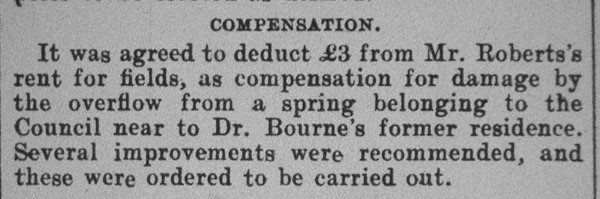
Mr Bourn’e residence was Abbotsfield, in High Street